Work and Power
Work is the measurement of force * the distance and is measured in Joules, work can only be present if the force and the distance are parallel to each other, . For example if you are climbing up a stair the distance will be the vertical height of the stairs and the force would be your weight. Power is how much work is done in a period of time Power = work/time, and is measured in Watts. For example if a person put in 50J of work in 5 seconds then that is equivalent to 10Watts of power.
Work and Energy Relationship
Work is Equal to the change in Kinetic Energy and is also equal to the change in Potential Energy. So if we know one of them we know the rest, But that does not mean they have the same equation Work is equal to distance * time, and Kinetic Energy is equal to 1/2 mass*velocity^2, and Potential Energy is equal to mass * gravity * height.
Kinetic energy is the energy that has to do with an object moving horizontally, and Potential Energy is the amount of energy an object has at a set height (vertically).
So if an object was on ground level and had a weight of 500N and was going at 5m/s then the object has 2500 Joules.
Conservation of Energy
Energy is neither created nor destroyed. The conservation of energy in similar to the conservation of momentum. You start out and end with the same amount of joules, the only thing different in this case is that the energy changes its form, but is still constant. In a roller-coaster, the first drop is always the highest then the rest do not matter in height as long as they are shorter than the first one. The coaster will keep on going. For example if it started with 1000 Joules of potential energy, when it drops and reaches the ground it still has 1000 Joules but of Kinetic Energy.
Machines
A machine is basically an object which makes it possible for a person to exert little force on an object that needs a big force, but while doing that the distance will also increase making the work similar in both cases (BigForce*SmallDistance = SmallForce *BigDistance)
Fin * Din = Fout * Dout
Work1 = Work2
If a person where to lift an object straight into a truck and the other uses a ramp, both would be using the same amount of joules, as force the person without a ramp he exerts a big force over a small distance, but with a ramp, the force is smaller with a bigger distance.
Thursday, February 26, 2015

Tuesday, February 3, 2015
Unit 4 blog post
During the month of January we have focused on quiet a few topics, which I personally enjoyed and understood better than previous Units because I found great interest in them.
The topics which we firmly studied where:
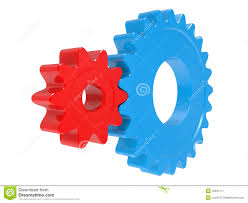 For example, look at the picture on the left, if the gears where moving, the red gear would have a greater rotational velocity than the blue gear because it will make more turns than the blue gear over a certain period of time. But their tangential velocity will be equal because they are moving at the same amount of notches every second.
The topics which we firmly studied where:
- Rotational and Tangential Velocity
- Rotational Inertia
- Conservation of Angular Momentum
- Torque
- Center of mass/gravity
- Centripetal force
Now let me share my knowledge by explaining everything I have learned in these topics.
Rotational and Tangential Velocity
The difference between Rotational and Tangential velocity is simple, Rotational velocity is the amount of time it takes for an object to make a complete circle. Tangential velocity is just the normal linear speed.
Rotational Inertia
Rotational inertia is the amount of force you need to move an object. This is related with the velocity of an object as well. If an object has a great rotational inertia it will have a low velocity vise versa. There are several ways to change the rotational inertia, for example if a person is spinning on a chair, by bringing his arms closer to his body he is decreasing his rotational inertia, and if he is spreading his arm then he increases his inertia because of the mass away from the center of the object.
Conservation of angular Momentum
Conservation of angular momentum is just the same idea of a skater spinning while decreasing her inertia and increasing her velocity, she can change that straight away while keeping the same exact momentum.
Inertia 1 * velocity 1 = Inertia 2 * velocity 2
Torque
Torque is the force that makes an object rotate on a axis. For example if a ruler is balanced on a axis that means that the net torque adds up to zero, so both sides have the same torque.
Torque = lever arm * force, so if you want to find out a missing force or lever arm if all the rest are given, you use this formula
lever arm * force = lever arm * force
Center of Mass
Center of mass is the point where the mass is concentrated if the center of mass is over the base of support then therefore, the object will stay stable and not topple over. But if it exceeds the base of support then the object will topple over, the pictures below describes the center of mass toppling over the base of support.

Centripetal force
A centripetal force is a force that makes an object follow a curved path, the direction of the force is inwards to the center of the curvature of the path. For example in a washing machine, the dryer spins the clothes around in a fast speed then the centripetal force is acting on the clothes but not the water, so the water escapes through the holes in the dryer while, the clothes remain in the dryer by the centripetal force.
Subscribe to:
Posts (Atom)